| i-ESG | Insight Letter | November 2026 |
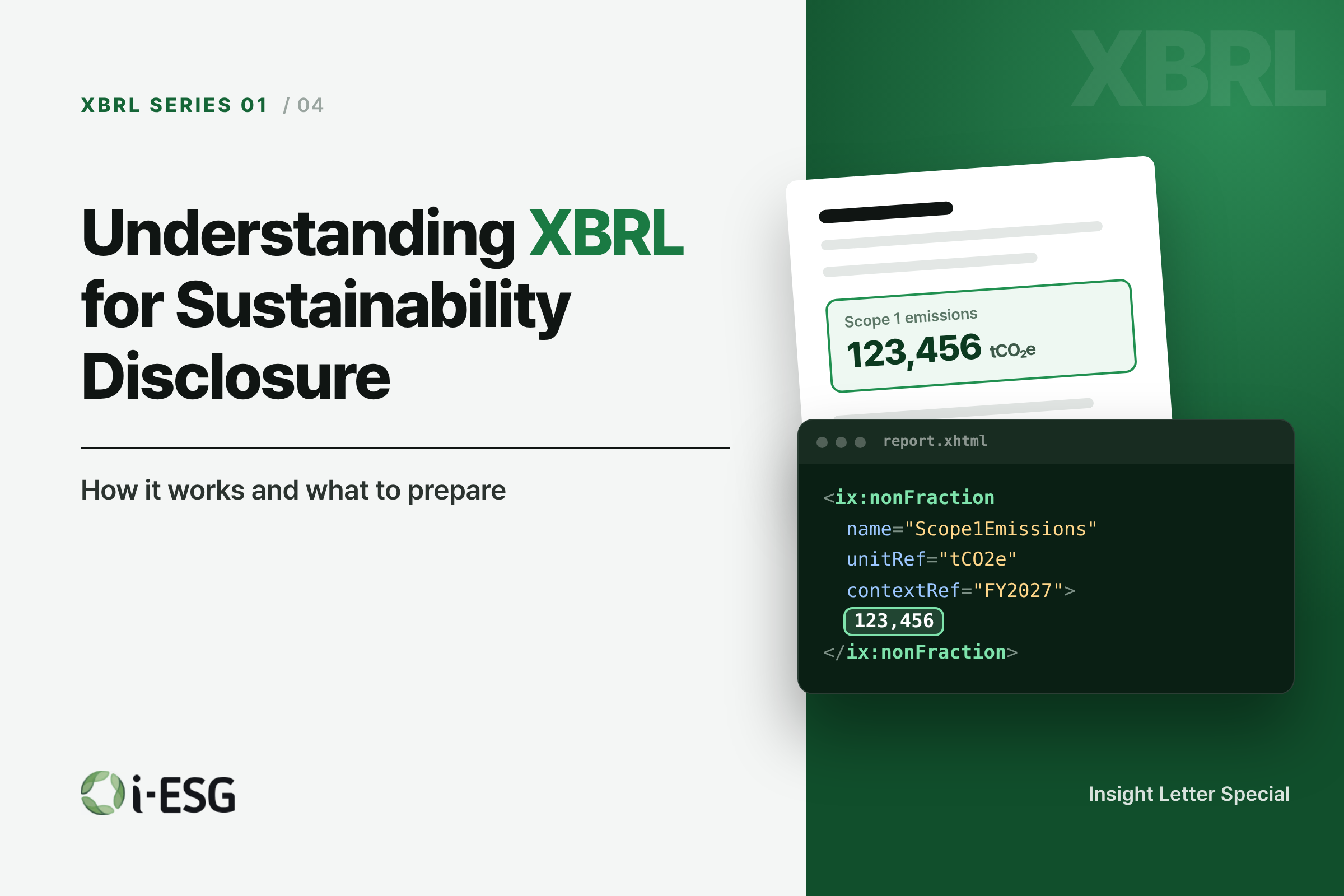
Special · XBRL Series ① Understanding XBRL for Sustainability DisclosureHow it works and what to prepare A primer for disclosure teams new to XBRL: why it matters now, how it is structured, how it is used, and where to start | XBRL Series 4 parts Part 1 What is XBRL This issue | With this issue, the i-ESG Insight Letter begins a series on XBRL, which is being adopted rapidly across ESG disclosure standards. Part 1 covers why XBRL preparation matters now, what XBRL is, how it is used, and where Korean companies can start. Suppose you need to compare Scope 1 emissions across 100 companies. With PDF reports, you open each file and look for the emissions table. Even with the numbers in a spreadsheet, you still have to check the period, the unit and the sites included before comparing anything. Financial reporting has used XBRL to cut this work. Once disclosure items are tagged, software can find and read the data it needs. ESRS, ISSB and GRI have each published an XBRL taxonomy, a dictionary of tags, for their standards. In this article, “taxonomy” means an XBRL tag dictionary. It is not the green taxonomy (such as the EU Taxonomy or K-Taxonomy) that classifies environmentally sustainable activities. | 01 Why prepare nowTaxonomies for the global standards are already published, and data for Korea’s first mandatory disclosures will be collected from January 1, 2027. XBRL is an international standard that tags disclosure items so software can read them, and a taxonomy is the dictionary of those tags (see Section 02 for the structure). According to XBRL International, XBRL is used in 65 countries and almost 220 reporting implementations. The case for preparing now has three parts: Korea, overseas, and how disclosures are read. 1-1Korea: sustainability information moves into the business reportUnder the government’s final plan (July 8, 2026), KOSPI-listed companies with consolidated assets of KRW 10 trillion or more must disclose sustainability information starting with the business report for fiscal year 2027, filed in 2028. The scope is set to widen to companies with KRW 5 trillion or more the following year. Financial statements in business reports are already filed in XBRL, and coverage is being extended step by step to the notes.
According to the Financial Supervisory Service (FSS), non-financial listed companies began filing notes in XBRL with their FY2023 business reports (filed in March 2024), and coverage has widened each year. In the financial sector, 28 listed companies with standalone assets of KRW 10 trillion or more came into scope from their 2025 half-year reports. In October 2026 the FSS also announced plans to improve Open DART and revise its XBRL taxonomy. It will release a taxonomy reflecting accounting changes such as K-IFRS 1118 from 2027, and named “building an AI-ready disclosure data foundation” as a future task. | Government plan | The policy and timetable for disclosing sustainability information in the business report have been issued as the government’s final plan. | | Under legislative review | The amendment to the Capital Markets Act that would provide the legal basis is under review by the National Assembly’s National Policy Committee. The obligation arises only after the amendment is passed and takes effect, and details may change during review. | | Undecided | Whether sustainability information must be filed in XBRL, and which taxonomy would apply, has not been announced. |
Waiting for the filing format to be finalised could push preparation into the first disclosure cycle. Collection of the first reportable data begins on January 1, 2027. 1-2Overseas: all three standards now have a taxonomyISSB, ESRS and GRI have each produced their own taxonomy. ISSB and ESRS published proposed updates in the second half of 2026 and have closed their consultations. Whether and when tagging becomes mandatory differs by standard. ISSB Global | | Taxonomy | Published April 2024. Reflects IFRS S1 and S2. | | 2026 | Proposed update published July 29, reflecting the December 2025 amendments to greenhouse gas disclosures in IFRS S2. Comments closed September 28. | | Tagging | The ISSB provides the taxonomy. Whether to require tagging with it is decided by each jurisdiction’s regulator. |
| ESRS EU | | Standard | The European Commission adopted the revised ESRS as a delegated regulation on July 3, 2026. It was published in the Official Journal on September 21 and entered into force on November 10. | | Taxonomy | The taxonomy for the revised ESRS is still a draft. EFRAG released it on September 17, closed the consultation on November 11, and plans to submit it to the European Securities and Markets Authority (ESMA) and the European Commission by year-end. | | Tagging | There is currently no tagging obligation. Under the Omnibus Directive, the tagging requirement is deferred until detailed rules are in place. The start date will be set after the regulatory technical standards (RTS) are adopted. |
| GRI Global | | Taxonomy | Published June 19, 2025. Covers the Universal, Sector and Topic Standards. | | Feature | Designed for a high level of alignment with the ISSB and ESRS XBRL taxonomies. | | Filing | Provided as the means to file digital reports with GRI, either directly or through an online form. |
|
Under the EU Omnibus Directive (Directive (EU) 2026/470, in force March 18, 2026), CSRD reporting now applies only to companies with more than 1,000 employees and net turnover above EUR 450 million. 1-3The way disclosures are read is changingXBRL International explains that tagged disclosures make it easier for investors to find information and compare companies, and for intermediaries such as data providers to process it. Korean financial reporting already offers an example of XBRL improving access for foreign investors. In August 2025 the FSS said that English-language note information became available in real time once 28 listed financial companies with standalone assets of KRW 10 trillion or more filed the notes to their half-year reports in XBRL. Companies with many overseas investors can pair tagging with English labels in their sustainability disclosures to make that information easier to find. | 02 What is XBRLAn international standard that attaches tags identifying the disclosure item to the figures and text in a report. XBRL (eXtensible Business Reporting Language) is an international standard that makes corporate disclosures readable by computers. XBRL International compares XBRL tags to product barcodes. Just as a checkout scanner reads a barcode to identify a product, software reads a tag to identify which disclosure item each figure represents. 2-1Key features| International standard | Maintained by XBRL International, a not-for-profit consortium. The standard itself is free for anyone to use. | | Report format preserved | The report keeps its format. Tags are attached to the figures and text inside it. | | Multilingual labels | The same item can carry both Korean and English labels. An overseas investor sees “Scope 1 total emissions” in a Korean-language report through the English label of the same tag. | | Pre-filing validation | Validation rules are applied at filing to catch format errors. |
2-2StructureTagging first requires a digital dictionary that defines the disclosure items. This dictionary is the taxonomy. A tag carries the item name together with the information needed to interpret the value. Suppose a report contains the line below. A person checks the column header for the year and the footnotes for the reporting boundary. In XBRL, the unit, period and reporting entity are recorded with the value so that software can read the same information. A line in a report (example) Scope 1 emissions 123,456 tCO₂e |
| Information in the tag | In this example |
|---|
| Disclosure item | The “Scope 1 total emissions” item in the taxonomy | | Value | 123,456 | | Unit | tCO₂e | | Period | January 1 – December 31, 2027 | | Entity and boundary | Entity identifier, consolidated basis |
The figure is illustrative. Key terms | Taxonomy | A dictionary of tags that defines the items of a disclosure standard in digital form. Not the same as a green taxonomy. | | Element | A single item in the dictionary | | Instance | The file a company submits, with actual values placed in tags | | Dimension | A basis for breaking a value down by site, business segment, calculation method and so on. Splitting Scope 2 emissions into location-based and market-based is one example. | | iXBRL Inline XBRL | A way of embedding XBRL tags in a human-readable report, so the same file serves people and software. |
2-3How XBRL is appliedOnce a disclosure standard is set, its items are carried into a taxonomy. Companies then find the matching item in the taxonomy for each value in their report and tag it. Step 1 Disclosure standard Decide which standard to report under, such as ISSB, ESRS or GRI Step 2 Taxonomy The standard’s items are turned into a tag dictionary Step 3 Company report The company tags each value and files the report Step 4 Data use Investors, regulators and rating agencies read it the same way 2-4How it differs from a conventional report | PDF report | XBRL-tagged report |
|---|
| How it is read | Read on screen, or text and tables extracted | Read on screen, or disclosure items identified by tag | | Finding a figure | Search by table title and line-item name | Search by common tag | | Unit and period | Checked in table titles, column headers and footnotes | Unit and period or reference date linked to each figure | | Cross-company comparison | Locate and match items report by report | Gather figures by common tag, then check comparability |
| 03 Where and how it is usedHow investors and rating agencies, regulators and companies use XBRL, and the limits of narrative information. 3-1Uses by user groupApplying the user benefits described by XBRL International to sustainability disclosure gives the following. | Investors and rating agencies | Finding information and comparing corporate performance becomes faster and more accurate. Example: gathering Scope 1 and 2 emissions from many companies under the same tag for comparison | | Regulators | Data collection is streamlined, and market and sustainability risks become easier to understand. Example: collecting filings by item to check for omissions and errors | | Companies | Beyond compliance, companies can monitor their own performance and benchmark against peers. Example (future): Korea has no tagged sustainability disclosures yet. Once filings accumulate, companies will be able to benchmark against peers and manage Korean and English reports from the same data. |
3-2Limits of narrative informationSustainability reports contain many items explained in prose, such as governance and transition plans. Tagging a transition plan makes it possible to collect the explanations of many companies. But to compare what each company plans to do, someone still has to read the text. Standard setters are still refining the level at which narrative information should be tagged. 3-3Connection to financial informationThe ISSB Standards are designed for sustainability information to be read alongside the financial statements. The IFRS Foundation intends the Accounting Taxonomy and the Sustainability Disclosure Taxonomy to be used together, but designed them as separate taxonomies so that either can be used without the other. Before tagging: check how internal data is defined Even for the same “Scope 1 emissions”, a difference in reporting period or sites included still has to be checked after the tag is found. A tag only says which item a data point is. Defining the data comes first, and that is the company’s job. |
| 04 Where Korean companies should startFour preparation steps that can proceed before the filing format is finalised. The ISSB taxonomy is already available, and Korea’s disclosure standards (KSSB) are based on IFRS S1 and S2. Financial statements in business reports are already filed in XBRL. How sustainability information will be filed in XBRL is not yet settled, but the basis for preparing is in place. The reference date is January 1, 2027. For companies with a December year-end, the first reportable data is collected from that date, so metric definitions need to be fixed beforehand. If a definition changes partway through the year, the annual figures have to be reconciled again. Before January 1, 2027 | 01 | Fix the definitions of core metrics Starting with metrics that will be disclosed, such as emissions, document the definition, unit, reporting period and sites included. This is the basis for matching internal metrics to taxonomy items later. Output Metric definition document | Owner ESG, EHS |
During 2027 | 02 | Review the finance team’s XBRL process for notes Learn how the finance team selects tags and checks for errors before filing its XBRL notes. Decide who will tag and who will review sustainability information within the business report timetable. Output Tagging and review procedure memo | Owner Finance (disclosure), ESG | | 03 | Map internal metrics to the taxonomies Start with the ISSB taxonomy, because Korea’s sustainability disclosure standards are built on the ISSB Standards. Companies with EU operations that may fall under the CSRD should also look at the ESRS taxonomy, and companies reporting under GRI at the GRI taxonomy. Mark separately the items that the Korean standards, unlike the ISSB Standards, leave optional: sustainability-related risks and opportunities beyond climate, the per-tonne internal carbon price, and industry-based metrics. Output Metric-to-taxonomy mapping table | Owner ESG, overseas subsidiaries |
Ongoing | 04 | Track developments in filing requirements In Korea, follow the National Assembly’s review of the Capital Markets Act amendment and any announcement from the financial authorities on the filing format. Overseas, follow EFRAG’s finalisation of the revised ESRS taxonomy, ESMA’s timetable for the regulatory technical standards, and the finalisation of the ISSB taxonomy update. Output Quarterly developments memo | Owner Disclosure, ESG |
Next · ② ESRS XBRL
Part 2 looks at the draft XBRL taxonomy for the revised ESRS that EFRAG released in September 2026: what has changed from the 2024 version, and what it means for Korean companies’ disclosure preparation. | Sources XBRL International, What is XBRL? IFRS, Using the IFRS digital taxonomies: The Taxonomy architecture (2026.6) IFRS, IFRS Sustainability Disclosure Taxonomy IFRS, ISSB proposes update to taxonomy (2026.7.29) EFRAG, Draft ESRS XBRL Taxonomy consultation (2026.9.17) Linklaters, EFRAG consults on the draft XBRL taxonomy for the revised ESRS Accountancy Europe, Omnibus explained: key changes to the CSRD and CSDDD (Directive (EU) 2026/470) CoreFiling, The CSRD Omnibus I simplification project is now complete (2026.9.22) GRI, A digital leap forward for sustainability reporting (2025.6.19) Financial Services Commission, Plan for Institutionalising Sustainability (ESG) Disclosure, final (2026.7.8, in Korean) Financial Supervisory Service press release, XBRL note filings by listed financial companies completed (2025.8.24, in Korean) Financial Supervisory Service press release, Open DART improvements and XBRL taxonomy revision (2026.10.14, in Korean) | i-ESG Solution From collection to management, analysis and report generation, ESG data is handled in a single flow. | Data standardisation | Data is aligned to i-ESG’s own metric backbone of 1,002 indicators. | | Figures and evidence | Organisational boundaries are structured, and figures are managed together with their evidence. Calculation covers Scope 1 and 2 through all 15 Scope 3 categories. | | AI analysis | Every analysis result shows the source quotation and its location. |
20 million+ ESG-specific data points · 17 patents Contact mkt@i-esg.io | i-ESG An ESG data collection, management and AI analysis solution built on a proprietary data backbone of 1,002 indicators.
For All Actions Sustainable. LinkedIn YouTube i-ESG Inc. | 366 Hangang-daero, Yongsan-gu, Seoul, Republic of Korea | Tel. +82 2 3211-4374 | mkt@i-esg.io This newsletter is provided for general information only. Details may change as the regulations are finalised. © 2026 i-ESG. All rights reserved. |
|